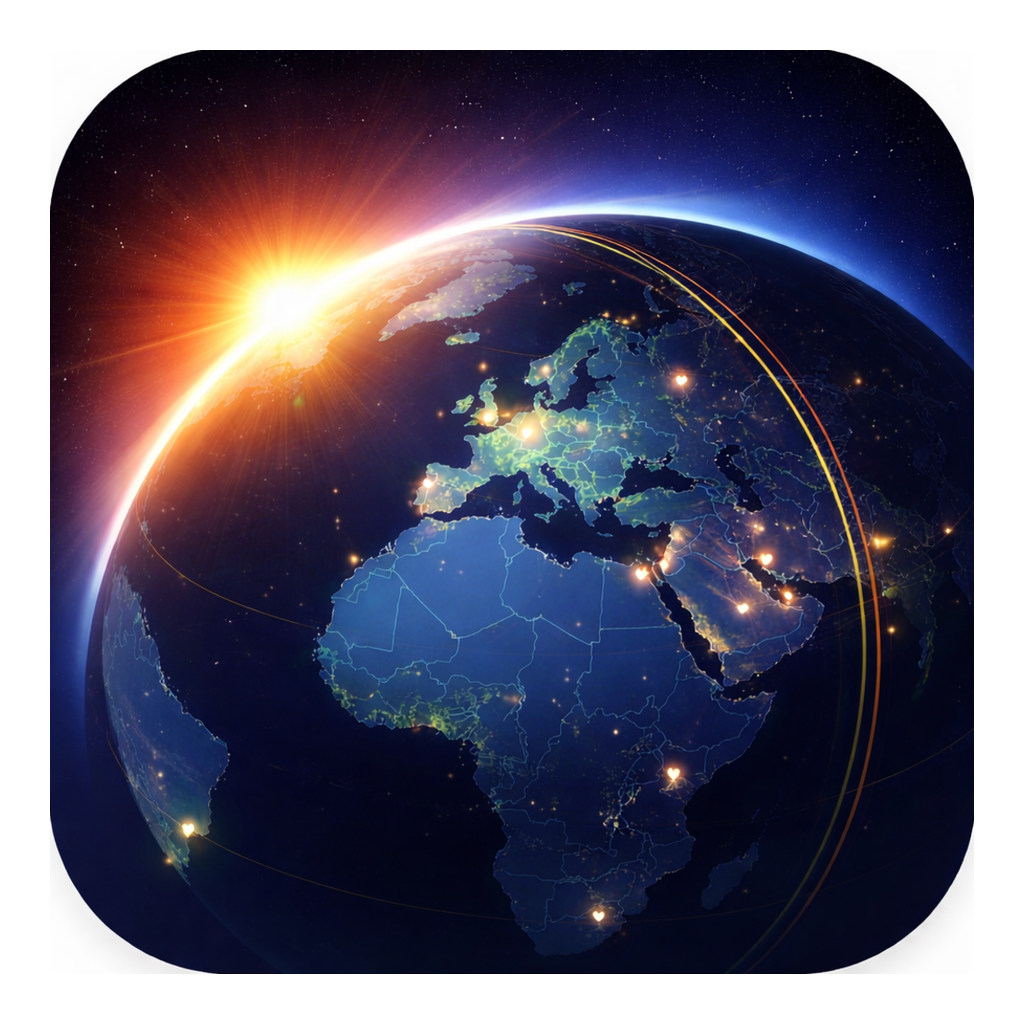
people are experiencing sunrise right now
Loading globe…
Drag · Scroll · Double-click to reset
Free · No registration · Takes only a few seconds
Start your day with the world
Every sunrise is shared by millions of people.
Before diving into emails, news or social media, take a moment to look at our shared planet. Watch the first light sweep across the Earth and remember that, somewhere, millions of people are beginning a new day alongside you.
おはよう (Ohayo) is the Japanese word for "good morning." It is one of the first words spoken at the beginning of the day—a simple greeting to the dawn and to the people around you.
On OhayoWorld, you can send an anonymous Ohayo from your city and see greetings appearing across the globe in real time. Each glowing pulse represents an Ohayo sent during the last 30 minutes, creating a living map of people welcoming a new day together.
Invite your friends to join at the same moment and watch a galaxy of Ohayos light up the world.
A small daily ritual. One shared sunrise.
Looking to turn this into a daily habit? Read our guide to slow mornings — the art of beginning the day with intention.
Gather the world
Create a private OhayoWorld Gathering and invite friends, family or colleagues to send an Ohayo together. Watch everyone appear live on the globe.
Create a Gathering →About OhayoWorld
The day/night terminator
The terminator is the moving boundary separating the sunlit (day) side of Earth from the dark (night) side. It always forms a great circle and sweeps westward as Earth spins — completing a full circuit every 24 hours.
On this globe the terminator is computed in real time using a simplified version of the Jean Meeus solar position algorithm (accuracy better than 1°). The blue shading shows the night hemisphere.
Seasonal variation
Earth's axis is tilted roughly 23.4° relative to its orbital plane. This tilt means the terminator is rarely parallel to the meridians:
- Equinoxes (≈ March 20, September 23) — the terminator passes through both poles; day and night are nearly equal everywhere on Earth.
- June solstice (≈ June 21) — the North Pole is in permanent sunlight; the Arctic Circle experiences midnight sun while the Antarctic Circle has polar night.
- December solstice (≈ December 21) — the reverse: the South Pole is in permanent sunlight.
Why sunrise times vary
At the equator, days are roughly 12 hours long throughout the year. At higher latitudes, the daily arc of the Sun grows or shrinks with the seasons. Above the Arctic and Antarctic Circles (±66.6°), the Sun never sets in summer (midnight sun) and never rises in winter (polar night).
About the sunrise count
The counter estimates how many people are currently inside the sunrise band — a narrow zone where the Sun is between −6° and +6° above the horizon on the morning (eastern) side of the terminator. This corresponds to civil twilight and the first minutes after sunrise.
The calculation uses a 0.25° population density grid (~28 km cells) derived from WorldPop 2020 data, updated every 30 seconds. All data is processed locally; no external request is made at runtime.
The 3D globe — technology
The globe is rendered in real time using WebGL (the browser's built-in hardware-accelerated 3D graphics engine) through the open-source globe.gl library, itself built on Three.js. The surface textures — natural-colour relief and city night lights — are derived from NASA's Blue Marble satellite imagery.
The camera is initially positioned at an altitude of about 2.5 times Earth's radius. At this distance you can never see both poles at the same time: each viewpoint reveals roughly 43 % of the Earth's surface. To explore the opposite hemisphere — and see the other pole — simply rotate the globe.
What should we add next?
Featured in
Featured OhayoWorld somewhere? Let us know through the form above. We may add your article, video, or website to this list.